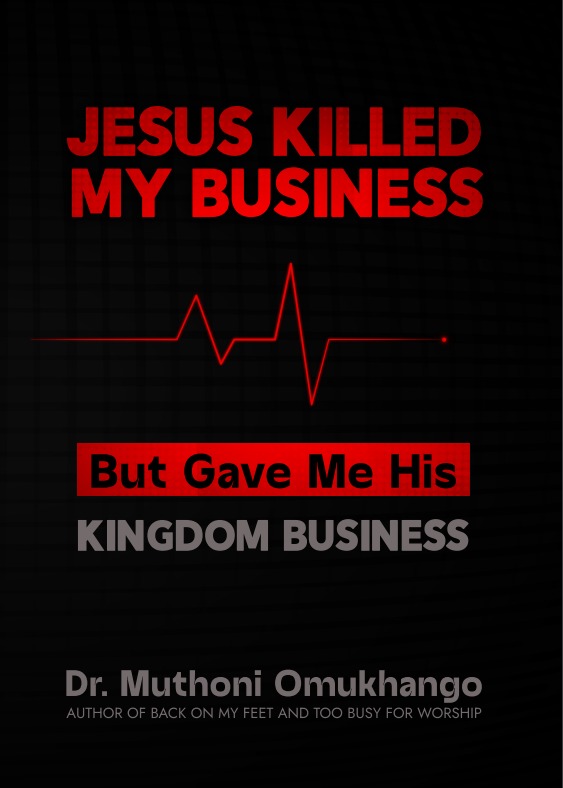
Jesus Killed
My Business
KINGDOM BUSINESS
What happens when the business you prayed for succeeds, but God asks you to walk away from it? This is my story of wrestling with God, surrendering control and discovering that His purpose for my life was bigger than the future I had carefully designed for myself.
Sometimes surrender looks like loss before it looks like purpose.
Calling
Obedience
Kingdom
What if your good plan is not God's final plan?
I was a businesswoman. I understood enterprise. I believed my business could finance ministry and release my husband to serve God without worrying about provision for our family. It made sense.
Then came an instruction I did not want: close the business and join my husband in ministry.
My first response was not immediate surrender. I argued. Had God not given me the business? Had He not made it successful? Was it not already serving Kingdom purposes?
That conversation exposed something much deeper than business. It exposed my struggle with control.
Purpose rarely travels in a straight line.
Looking back, I could see my journey reflected in Jacob: calling, resistance, wilderness, wrestling, surrender and finally transformation.
Called
Long before I understood the shape of my future, God had already begun speaking about purpose.
I Built My Own Plan
Business matched my gifting, background, ambition and understanding of success.
God Interrupted It
The interruption I initially resisted became the doorway into deeper obedience and calling.
Kingdom Business
Surrender did not end usefulness. It redefined success, work, influence and stewardship.
When God touches what you thought defined you.
Purpose can take a zigzag path.
Detours do not automatically mean you have missed God. Some turns become the classroom in which calling is clarified.
A good plan can still compete with God's plan.
The hardest things to surrender are often not sinful things, but good things we have begun to believe we cannot live without.
Obedience may cost before it makes sense.
We often want the whole explanation before we obey. God frequently gives enough light for the next step.
Wilderness seasons are not necessarily wasted seasons.
Hidden seasons can strip away self-reliance and make space for a clearer dependence on God.
God may change the name you answer to.
Jacob's encounter changed more than circumstances. It changed identity. Transformation often reaches the way we understand ourselves.
Kingdom business asks a different question.
Instead of asking only, “What can I build?” we begin asking, “Lord, what are You building, and how do I serve it?”
Jesus had a Kingdom model.
My journey eventually forced me to rethink not only what I was building, but how Kingdom work is built. Jesus did not merely gather crowds. He formed people.
His model centred on discipleship, teaching, lived example, faith, obedience and servanthood.
The question is not only, “Is this good?”
The deeper question is: “Is this what God has asked me to build in this season?”

Dr. Muthoni Omukhango
I know what it feels like to have a plan that makes perfect sense and still hear God asking for something different. Jesus Killed My Business: But Gave Me His is not theory written from a safe distance.
It is my testimony of ambition, wrestling, surrender, obedience and rediscovering purpose.
Through my own journey and the biblical journey of Jacob, I invite believers, entrepreneurs, professionals and ministry leaders to examine the places where our desire for control may be competing with God's direction.
What if God is not destroying your future... but redirecting it?
Sometimes surrender feels like loss because we can see what we are releasing but cannot yet see what God is placing in our hands.
Begin The JourneySUBSCRIBE TODAY…
Anointed From Birth
Chapter One traces the beginnings of a calling that was present long before it was fully understood. Using the story of Jacob and Esau, the chapter establishes the idea that God’s purpose can precede our awareness of it.
Purpose Before Understanding
Jacob’s future was spoken about before birth, and in a similar way, the chapter reflects on how purpose can begin taking shape before a person has the maturity to recognise where it is leading.
Two Worlds Growing Side by Side
The chapter then moves into my childhood and early church life. I grew up in a Pentecostal environment where serving God was normal. I participated in Sunday School, youth activities, crusades, church plants, worship, intercession and other forms of ministry. At the same time, I was being raised in a business family and was being prepared for a future in entrepreneurship. Those two worlds existed side by side, but business was the future that made the most sense to me.
The Prophecy That Did Not Fit My Plans
A major turning point came during a Weekend Revival when a minister prophesied that I would preach the Gospel to the nations and train and empower pastors. I knew the word was directed at me, but it did not fit the life I expected. I had been intentionally groomed to take over the family business, and I saw entrepreneurship as the natural use of my gifts. Because the prophecy seemed so disconnected from my reality, I pushed it aside and returned my focus to business.
The Calling Did Not Disappear
Soon afterwards, I experienced a deeper spiritual stirring. I felt God calling me beyond the life I had already imagined. This created an internal struggle because, even as a child, I wanted control over my future. I wanted the freedom to make my own choices while still hoping those choices would lead to greatness. Surrender was already becoming a central issue in my relationship with God.
Scripture, Dreams and Spiritual Sensitivity
My spiritual sensitivity deepened further through Scripture and dreams. A cherished NIV Bible became part of my desire for knowledge and spiritual growth. I spent time reading the book of Revelation and later had a vivid dream connected to the Island of Patmos. These experiences strengthened my awareness that God was speaking to me in ways I could not easily dismiss.
“Before I formed you in the womb I knew you... I appointed you as a prophet to the nations.”
“I Have Called You to Be a Prophet to the Nations”
The message became even clearer in another dream. In it, I was confronted by a massive trailer and heard the words, “I have called you to be a prophet to the nations.” After waking, I opened my Bible and landed on Jeremiah 1:5. The repetition was striking. The prophecy, the dreams and the Scripture were all pointing in the same direction.
I wanted to build an empire. God was pointing somewhere else.
By the end of the chapter, the tension is clear. I still wanted to build a business empire that would finance God’s work, yet I could no longer ignore the possibility that God was calling me into something different. I began to sense that there was another calling within me beyond business, even though I was not yet ready to surrender fully to it.
God’s calling can be present before we understand it, and He may speak repeatedly until we are willing to listen.
Personal ambition meets divine purpose.
Chapter One sets up the larger journey of the book: the struggle between personal ambition and divine purpose, and the gradual movement from control towards surrender.
Purpose Takes A Zigzag Path
Chapter Two explores the reality that the journey to purpose is rarely straight or predictable. Detours, wrong turns, difficult relationships, setbacks and unexpected responsibilities can all become part of the process through which our direction is exposed, corrected and refined.
Purpose Does Not Always Follow a Straight Line
The chapter begins with the reminder that many men and women in the Bible did not travel predictable routes towards purpose. Their journeys included twists, setbacks and unexpected changes of direction. These zigzags are not necessarily disadvantages. They can become valuable learning experiences that shape and refine the path towards our final destination.
Jacob Took His Blessing By ‘Force’
The story of Jacob and Esau shows the danger of trying to force into existence something God has already spoken. Rebekah and Jacob used deception to secure Isaac’s blessing, even though a prophecy had already declared that the older would serve the younger. The blessing came, but so did painful consequences, including broken relationships, hatred and Jacob’s departure from home.
I Also Took My Blessing By ‘Force’
By the time I finished high school, I believed strongly that favour rested upon my life and that I was destined for greatness. I left Embu for Eldoret to pursue Business Management with Accounting, Finance and Banking. The path made sense because entrepreneurship was already deeply rooted in my upbringing and gifting.
Yet I had buried the prophecies and dreams of my childhood. I had not written them down, so there were no dots to connect when I needed direction. What looked like a good opportunity was taking me further along a path that did not align with what God had already spoken.
“Write the vision and engrave it plainly... For the vision is yet for the appointed future time.”
The Power of Company
One of the strongest warning signs was the company I kept. During the period after high school and into university, the people around me pulled me away from my love for God, His service and the calling upon my life. Their influence contributed to poor decisions, unhealthy relationships and a growing distance from the person I had once been.
Slowly, I began trying to find my way back. My mother became an emotional pillar and spiritual anchor through her prayers and support. I also found a church community that offered the possibility of returning to faith, although for a time I continued living between light and darkness.
God Sustains What He Has Assigned
Another alarm bell was the lack of provision during university. My parents’ businesses collapsed, and the financial security I had known disappeared. During the same difficult season, I became a mother at nineteen. I had to take responsibility for my daughter, move from the main campus to evening classes and find work.
Motherhood became both a weight of responsibility and a pathway towards redemption. I could no longer play the same games with my life because the consequences would now affect someone else. My daughter grounded me and forced me to begin looking at life differently.
I Had to Return to the Place Where I Missed the Step
Romans 8 became an anchor during this season. I knew I had been called according to God’s purpose, even though I had lost sight of what that purpose was. I wanted the final outcome without passing through the process of returning, surrendering and being restored.
I came to understand that God would not simply skip the steps I had missed. Like a student returning to school after dropping out, I needed to go back to the point where I had left the process and begin again from there.
The path looked right. But I was travelling in the wrong direction.
Business, university and entrepreneurship appeared to form a sensible future. Yet the deeper I travelled along the path I had chosen, the more disconnected I became from the calling God had already revealed. The chapter exposes the danger of assuming that what looks right, feels right or matches our gifts is automatically the direction God has assigned.
A zigzag does not have to become the end of the journey. God can use detours, consequences and difficult seasons to bring us back towards His purpose.
The wrong road can still become part of the lesson.
Chapter Two ends in the tension of waiting. I was beginning to believe again that nothing could separate me from the love of God, yet my physical reality still looked very different from the victory Scripture promised. I was learning that finding the way back to purpose would require patience, surrender and trust in God’s process.
The Bethel Altar: An Assurance
Chapter Three is about reassurance. God may allow the journey to become difficult and unfamiliar, but He does not forget what He has spoken. Through people, circumstances, opportunities and repeated reminders, He strengthens our faith and assures us that His promises remain intact even when fulfilment appears delayed.
Jacob’s Bethel Encounter
Jacob left Beersheba for Haran after the turmoil surrounding Isaac’s blessing. During the journey, he stopped for the night and had a dream of a stairway reaching from earth to heaven. God spoke first, reaffirming the promises given to Abraham and Isaac and assuring Jacob of His presence, protection, provision and commitment to bring him back to the promised land.
Jacob had previously taken matters into his own hands, but Bethel marked the beginning of a different posture. His journey of surrender had started. The encounter reminded him that relationship with God is initiated by God Himself and that His purposes are bigger than one person’s immediate circumstances.
“If God Will... Then I Will”
After God reassured Jacob, Jacob made a vow. He asked for God’s presence, protection, food and clothing, and promised that the Lord would be his God. The stone he had used as a pillow became a memorial of the encounter.
The chapter reflects on how easily Jacob’s words could sound like doubt. Yet God was patient with him. Jacob needed reassurance, and over the next two decades God would prove His faithfulness through protection, provision and fulfilment of His promises.
“I am with you and will keep careful watch over you wherever you may go... for I will not leave you until I have done what I have promised you.”
A Reminder of My Calling
My own “if God, then I” moment came around the time I was graduating from university. I had survived the university years through menial jobs and help from unlikely places. At the end of that season, I fell on my knees and asked God to bring me fully back into His fold. I no longer wanted to live half in and half out. I wanted to be all in.
Soon after praying, Pastor Ken called me unexpectedly. He and his wife Maria had been praying for me, and he told me that God wanted to redeem me back to Himself. The timing became an assurance that God was still watching over my life and His promises concerning me.
My Bethel Altar Was Set Up
The same day, I found the strength to leave a relationship that had become my greatest hindrance to faith. Within days, I had walked away from the life I knew with only a suitcase and a few clothes.
During the months that followed, I cried before God and struggled with the reality of starting again. I asked why life could still be so hard when I knew I was finally in His will. In that season I made my own vow: if God restored me to a life of purpose and fulfilment, I would serve Him wholeheartedly without reservations.
Like Jacob at Bethel, the altar was set up, the promise was made and the covenant became a memorial moment in my journey.
The Wilderness Was Retraining, Not Abandonment
My wilderness season lasted about three years. I had once viewed wilderness as simply a place of suffering, but I later came to understand it as a place of transformation and preparation.
I entered full-time service in Pastor Ken and Maria’s church and immersed myself in Bible study, prayer meetings and ministry. I needed to remain in the house of God so that I could fully leave my past behind. Over time, a paying job came and I was able to move into my own house with my children. A small flicker of light began to appear.
The Power of Divine Helpers
God also used people to strengthen the journey. At church I met Frank and Benta, and our families became closely connected. We attended church together, shared meals and supported one another.
Their friendship gave me accountability, encouragement and a sense that I was no longer walking alone. Between church service, caring for my children, fellowship and trying to make ends meet, there was less room for the distractions that had previously pulled me away.
Starting Again. Again!
Just as stability was beginning to return in Eldoret, Kenya entered the 2007 to 2008 post-election crisis. Fear for my life and the lives of my children forced us to leave. What was meant to be a temporary move became a permanent departure from Eldoret.
We eventually reached Embu safely, and I later moved to Nairobi looking for work. I struggled with the idea of starting over yet again because Eldoret had begun to feel like home. But another unexpected turn was waiting for me.
A friend named Bessy introduced me to a Kingdom Academy Bible College programme. I resisted it because the two-year programme would keep me in Nairobi when I still hoped to return to Eldoret. Yet after much reluctance, I filled in the registration form and submitted it. Once again, God’s plans were moving differently from mine.
I wanted stability. God kept moving me forward.
Chapter Three shows that reassurance does not always mean circumstances become easier. God reassured me of His presence, but the journey still included leaving relationships, starting over, wilderness training, dependence on others and repeated relocation. His assurance was not that everything would be comfortable. It was that He would remain present and faithful through it.
God gives us memorial moments so that when the journey becomes uncertain, we can remember what He said and trust Him to fulfil His promises in His time.
Bethel was not the destination. It was the assurance for the journey.
Chapter Three moves from reassurance into preparation. God had reminded me that He was still present, restored me to fellowship, surrounded me with divine helpers and redirected my path through circumstances I could not control. The promise remained, but there was still a long process ahead before purpose would become clear.
Obedience Through Suffering
Chapter Four explores how obedience is often formed and strengthened through difficulty. Jesus learned obedience through the things He suffered, and the chapter connects that truth to both Jacob’s long years under Laban and my own season of retraining, financial pressure, blocked opportunities and gradual return to purpose.
Jacob’s Twenty Years of Labour
Jacob spent twenty years working for his uncle Laban. What began as an agreement to work seven years for Rachel became a long season of labour, deception and endurance. Laban gave him Leah instead of Rachel, and Jacob had to work another seven years for the woman he loved, followed by six more years before eventually leaving.
The experience became part of Jacob’s transformation. The man who had once deceived his brother now experienced deception himself. Through these years he learned lessons about integrity, honesty, consequences and obedience. By the time he left Laban’s house, he was no longer the same man who had arrived.
Under-qualified and Overqualified at the Same Time
I began Bible College in Nairobi while still hoping that political stability would return to Eldoret so I could go back home. Instead, I eventually gave up my house in Eldoret, moved my belongings to Nairobi and began another new life.
Because I had to support my family, I started applying for jobs in banks, Saccos and financial institutions. Again and again, I received the same responses: I was either under-qualified or overqualified. After sending hundreds of applications, I began to wonder whether God Himself was blocking my path into banking.
“Although He was a Son, He learned obedience from the things which He suffered.”
God Was Blocking the Path I Wanted
Deep within, I began to sense that the closed doors were not random. A banking career would have taken me further away from the purpose God had spoken over my life. I compared the experience to Balaam, whose path was blocked by an angel he could not initially see.
What felt like rejection was beginning to look more like intervention. God was not simply denying me an opportunity. He was redirecting me away from a path that would have carried me further from purpose.
The Breadwinner Paradox
I was carrying the weight of providing for my family, yet God began teaching me that He alone is the ultimate provider. My worth and success could not be measured only by my ability to be the breadwinner. Jesus taught His disciples to ask the Father for daily bread and to trust that He already knows what they need.
I began surrendering the anxiety of provision and learning to trust God one day at a time. Instead of carrying tomorrow before it arrived, I began focusing on seeking His Kingdom and trusting Him to provide for the needs of each day.
The Job I Had Not Planned For
When I asked the Lord what He wanted me to do after the banking doors remained closed, God used Bessy to connect me with a sales job at a perfume wholesaler. It was certainly not the Finance and Banking career I had studied for.
I took the job anyway. The salary was modest, but commissions were encouraging. I developed my sales skills, learned my way around Nairobi, earned income and strengthened the entrepreneurial abilities already within me. Slowly, life began making sense again.
Back on Track and On ‘Purpose’
Through Kingdom Academy, I had unknowingly returned to the exact point where I had veered away years earlier. At first I felt inadequate and planned to leave the programme as soon as possible. But within the first month, something had changed inside me.
I began to recognise how closely the Bible College aligned with the nations-focused calling God had spoken over my life. My doubts gave way to confidence and renewed purpose. I rededicated my life to Jesus again and made a commitment to cooperate with God for the two years of training.
God’s Voice Became an Everyday Lifestyle
I continued working during the day, attending Bible College in the evening and caring for my family in between. For the first time in years, I began experiencing fulfilment in the ordinary rhythm of daily life.
God’s voice was no longer an occasional encounter. I began involving Him in everyday decisions, from the routes I travelled to the meals I prepared. This changed my understanding of purpose. God’s presence was not limited to dramatic spiritual moments. He was present in the ordinary, and even the smallest responsibilities could carry divine significance.
I wanted the career I had trained for. God was training me for something else.
Chapter Four shows that obedience can involve closed doors, financial uncertainty, work that appears beneath our qualifications and seasons that do not resemble the future we imagined. Yet these same pressures can become the environment in which character is formed, dependence on God deepens and purpose becomes clearer.
Suffering does not always mean we are outside God’s will. Sometimes it is the classroom in which obedience, character and dependence on Him are being formed.
The doors that closed were helping me find the road I was meant to travel.
Chapter Four ends with my life beginning to align again. Work, Bible College, motherhood and daily dependence on God were no longer disconnected responsibilities. Together, they became part of the process through which I rediscovered purpose and learned to hear God in everyday life.
Hearing God Again
Chapter Five follows the restoration of my ability to hear God clearly and respond to His direction. As the noise of my past began to fade, God’s voice became more central to my daily life. He redirected my work, rebuilt my faith, taught me obedience and slowly brought the calling I had resisted for years back into focus.
God’s Divine Strategy for Jacob’s Wealth
After about twenty years with Laban, Jacob heard God tell him to return to the land of his fathers. By this point, God had already protected him from Laban’s schemes and given him a strategy through which his wealth increased. The instruction to leave came at the right time.
God reminded Jacob that He had seen everything Laban had done to him. The same God who had met him at Bethel had remained with him throughout the entire journey. Jacob could now hear God’s voice and respond, “Here I am.”
God Is Not Early or Late
Jacob’s story reinforced the importance of God’s timing. He had already built a family, accumulated wealth and grown through years of labour before God told him to move. The timing was not accidental.
God had prepared everything necessary before giving the next instruction. Even when Jacob could not understand the complete plan, he could trust that God was making everything beautiful and appropriate in its time.
The Past Eventually Lost My Trail
My past did not disappear immediately. Old friendships, temptations and regrets continued following me for a while. Memories of my mistakes reminded me of the person I had once been.
Yet God was more determined to bring me through than my past was determined to pull me back. I learned that I could not undo what had happened, but I could stop allowing it to define the present. With time, the past lost my trail and scent as God continued making me into a new person.
“Forgetting what lies behind and reaching forward to what lies ahead, I press on toward the goal.”
God Promised to Redeem the Lost Years
During this season, God gave me a specific promise that He would redeem the years the locust, cankerworm, caterpillar and palmerworm had eaten. I wondered what that restoration would look like.
I imagined dramatic possibilities. Perhaps a remarkable job, a large financial breakthrough or a happily-ever-after future. Yet I began to realise that the redemption of lost time might not happen through one spectacular event. It could unfold through obedience in the ordinary moments of daily life.
“What Do You Want, Lord?”
I reached a point where I was eager to obey God and asked Him simply to tell me what He wanted. Six months into Bible College, His instruction came. I was to leave my job at the perfume wholesaler.
The instruction did not make natural sense. I was a single mother who had only recently found stability in Nairobi. Yet this time I obeyed without prolonged resistance. I resigned, stopped sending out résumés and decided to trust God with our provision.
God Provided in Unexpected Ways
Friends, relatives and even strangers became part of God’s provision. For an entire year, my landlord did not ask me for rent even though we interacted regularly. He continued paying utilities while my family remained in the house.
During the same season, our six-kilogram cooking gas cylinder, which normally lasted only a few weeks, did not run out for about eight months. These experiences strengthened my confidence that circumstances could not place restrictions on God’s ability to sustain us.
A Season That Looked Like Doing Nothing
Without a job, I spent my days studying the Word, praying, fasting and reading books as God directed me, then attended Bible School in the evenings. While people around me sometimes encouraged me to look for employment, I began to understand that God was rebuilding the spiritual foundation I had neglected for several years.
What looked outwardly like inactivity became an intensive season of preparation. By the end of that year, I was praying for several hours each day and had developed a much stronger life of faith and prayer.
Learning the Value of Walking Alone
During this season, a friend from Bible College lent me When Women Walk Alone by Cindi McMenamin. The book helped me understand loneliness as an opportunity for personal and spiritual growth rather than something that had to produce resentment.
I learned to use alone time for prayer, growth and preparation. The season also taught me the importance of resting when the Holy Spirit requires rest. Like Elijah, who had to eat and sleep before a long journey, there are seasons when God strengthens us before the next assignment begins.
God Began Preparing Me for Marriage
God also used this hidden season to confront what I believed about relationships and marriage. I had ideas about the type of husband I wanted, but God began teaching me to distinguish between preferences and what I genuinely needed.
He redirected my attention towards spiritual maturity, unity of purpose, pastoral leadership in the home and a man who would become a stable foundation for my daughter and me. He also challenged me not to judge only by outward appearance, but to learn to see through His lens.
God Always Has a Plus-Plus Bonus
Towards the end of this season, my Bible College friend Patrick Omukhango got a job at Christian Literature Communications, CLC Kenya. Two weeks later, he told me about an opportunity to interview for a sales position there.
I accepted reluctantly because I was still expecting my future to unfold in banking and business. Yet Patrick and I now spent almost every day together through work, Bible College and church. At the time, we still regarded each other as brother and sister.
The Calling Came Back Into Focus
After graduating from Bible College, I had to declare whether I would pursue business or my fivefold calling. I struggled with the decision until another disappointment forced me to examine what God had actually spoken concerning my life.
I could not identify a moment when God had told me He had called me into business. Business had grown from my desires, upbringing, abilities and experience. In contrast, the prophetic words and dreams from my childhood all pointed towards ministry, preaching to the nations and training pastors.
Finally, I dropped to my knees and surrendered. “Lord, I surrender to you.” For the first time, the calling I had resisted for years became clear.
I kept asking God to bless my plan. He kept bringing me back to His.
Chapter Five reveals that hearing God again was not simply about receiving more words from Him. It required letting go of the past, obeying instructions that challenged common sense, trusting Him for provision, accepting hidden seasons of preparation and finally facing the calling He had been repeating since childhood.
Hearing God becomes transformative when His voice is followed by obedience. The more I listened and responded, the clearer His direction for my life became.
I was tired of fighting God. So I surrendered.
Chapter Five ends with the calling finally coming back into focus. Years of business ambition, personal plans, spiritual retraining, provision and preparation had brought me to a decision I had resisted for a long time. I surrendered to the fivefold calling God had spoken over my life and chose to align myself with His direction.
Why Do Humans Fight God?
Chapter Six confronts the struggle between human will and surrender to God. The desire for control has existed since Genesis, and it can cause us to resist God even when we know His voice clearly. Through Jacob’s wrestling encounter and my own prolonged resistance to closing a successful business, the chapter shows how surrender may come only after we have exhausted our strength.
Jacob Wrestled With God
As Jacob returned home after twenty years, he found himself alone at the Jabbok. There he wrestled until daybreak. During the encounter, his hip was dislocated, he received a blessing and his name was changed from Jacob to Israel.
The encounter brought Jacob back to the place God had promised to return him. God had kept him, fed him, clothed him, given him a family and prospered him. The wrestling encounter became another reminder that God had fulfilled His covenant and that Jacob’s identity was being transformed.
God’s Compensation Came in Seed Form
Around the same period, Patrick received a promotion from warehouse in-charge to Deputy General Manager. The promotion became another sign to me that God was in control of our journey.
A year after the proposal, we married in a wedding that became a testimony of God’s provision. Marriage became part of God’s redemption path for me. Patrick’s spiritual maturity and commitment to hearing and obeying God brought stability into my life and, over time, helped reconnect me with the prophecy spoken over me years earlier.
Books Became Our Pulpit
Patrick and I continued serving together at CLC Kenya, where our work became filled with testimonies of God’s intervention in the book industry. Books became a means through which the Gospel could reach people across nations.
CLC Kenya became our place of assignment, and books became our pulpit. Patrick carried an apostolic calling, while I carried prophetic and teaching grace. Work became meaningful as we sought to follow what the Father was doing and express it through our assignment.
“Your name shall no longer be Jacob, but Israel; for you have struggled with God and with men and have prevailed.”
Then God Asked Me to Step Away
After three years at CLC Kenya, God asked me to step down and care for our young family. Patrick and I both understood the instruction clearly, so there was little debate about it.
I began homeschooling our daughter, Aamo, while we prepared for another baby. This season felt like compensation. Our home was full of love, our needs were met and we experienced a level of stability that I had once tried to define through outward success.
The Thing That Leads to the Thing
Despite the stability, the desire for business returned strongly. I still wanted to explore my entrepreneurial ability and build something of my own. Eventually, I started a business consulting firm, registered it, hired staff and began expanding.
The business did not merely survive. It thrived. I was signing new clients, raising my consulting fees and building what looked like the foundation of the business empire I had always imagined. Because it was successful, it was easy to assume that success itself was confirmation that I was in God’s will.
Success Did Not Automatically Mean Alignment
My consulting work sometimes included insights I believed the Holy Spirit gave me concerning the businesses I served. One client, Elise, later returned to tell me that advice I had given her concerning an upcoming parliamentary bill had positioned her business for major growth.
Her appreciation strengthened my confidence, and the business continued expanding. Yet the more successful it became, the easier it was for money and achievement to overshadow the calling I had surrendered to only a few years before.
“I Want You to Close Your Business”
Then came the instruction I did not want to hear: “I want you to close your business and join your husband in ministry work.”
I argued with God. The business was successful. It provided for our family, supported needy children and enabled Patrick to serve in ministry without carrying the full financial burden. To me, everything about it looked useful and responsible.
Yet God repeated the instruction. I knew it was His voice, but I continued preparing to expand the business. I was planning a much larger office and preparing to employ around thirty people. I was determined not to stop.
The Weakness of Strong-Willed Individuals
Soon afterwards, illness interrupted my plans. What I thought would be a short setback continued for weeks, and the plans for the larger office and new staff stalled.
I was still determined to prevail. Yet this season exposed the danger of a strong will operating outside God’s direction. Determination can be praised as ambition and achievement, but if it competes with God’s will, it becomes a hindrance rather than a strength.
Not My Will, But Yours
Jesus became the model for surrender. In Gethsemane, He expressed what He desired but still prayed for the Father’s will to be done.
This became the deeper lesson for me. When our desires conflict with God’s direction, the answer is not to pretend that we have no preference. It is to bring our desires honestly before Him and still choose His will above our own.
God Touched My Hip to Limp
The following month, I experienced a miscarriage that brought my life to a halt. My staff tried to continue without me, but the business depended heavily on my guidance and client relationships.
I entered another season of darkness, frustration, sorrow and self-reflection. Deep within, I knew I had been contending with God. In that sorrow, I repented and asked Him to do with me as He desired.
I Finally Closed the Business
After several weeks, I returned to the office and knew the business had come to an end. The expansion would not happen. Three years of work were closing.
I gave my staff notice, moved the shelves back home and called my clients to explain that I was transitioning into ministry. Some could not understand why I would leave a thriving business for the uncertainties of ministry. Others suggested I could simply do both.
But that was not the instruction I had received. God had not asked me to add ministry to the business. He had asked me to close the business.
Eight Months of Fighting Ended in Surrender
It had taken eight months of fighting with God to reach that point. By then, I no longer had the strength to resist. I finally surrendered, and with surrender came the peace I had been searching for.
I recognised that my strong will had been one of the greatest hindrances in my faith journey. The months of sickness became like Jacob’s limp, a permanent reminder that resisting God further than necessary carries a painful cost.
I knew it was God. I still fought Him for eight months.
Chapter Six reveals how difficult surrender can become when our own plans are working. The business was successful, profitable and useful. Yet the question was never simply whether it was good. The question was whether it was what God had instructed me to continue doing.
Our education, experience, gifts, success and determination must never become stronger authorities in our lives than a clear word from God.
The business had to die so another harvest could live.
Chapter Six ends with the business finally closed and the fight with God over. Looking back, I could also see why the business season had mattered. I had needed to enter it, succeed in it and finally surrender it so that the lingering question of “what if” would no longer follow me into ministry. Like the grain of wheat Jesus described, something had to die before a greater harvest could emerge.
Change of Name
Chapter Seven moves from surrender into identity. Just as Jacob emerged from his encounter with God carrying a new name, Israel, I began to understand that God was not merely changing what I did. He was changing how I saw myself, how I understood my calling and how I would live from that point forward.
From Jacob to Israel
Jacob’s change of name represented much more than a new way of addressing him. His old name carried associations with following behind, grasping the heel, supplanting and overreaching. After wrestling with God, he received the name Israel.
The new name represented transformation, perseverance and a new identity in God’s purposes. Jacob’s past no longer had to define him. His relationship with God had changed him, and the new name marked that change.
My New Name: Neo
While I was still in Bible School, Patrick and his friend Boi began calling me Neo after we watched The Matrix. The name initially came as a joke, but they saw parallels between my journey and the character’s process of awakening, self-discovery and transformation.
Over time, the name became meaningful to me. It represented the reality that I was no longer defined by my past. I was becoming a new person with greater clarity about my identity in Jesus.
“Your name shall no longer be Jacob, but Israel; for you have struggled with God and with men and have prevailed.”
I Was No Longer Defined by My Past
My new sense of identity gave me confidence to move forward. My faith had become steadier, marriage was working well, and God was helping me in parenting. Even the death of my business no longer had the power to shake me in the same way.
I became willing to step out of the boat and test whether I could truly follow Jesus into the unknown. Like Peter, I found myself saying, “Lord, if it is You, bid me to come.” Ministry work was now the water I had been called to walk on.
My Transition From Business to Ministry
During my first year serving in the missions organisation, I received no remuneration, either monetary or in-kind. I wondered how we would survive in Nairobi without the income I could once generate through business.
Yet God had assured me that He had taken care of our needs. Month after month, provision came from unexpected sources. Bills were paid, the children remained in school and food remained on our table. The season was full of miracles, signs and wonders.
God Became My Employer
Because CLC Kenya was not paying me, there was neither a financial incentive to work harder nor a financial discouragement to do less. My focus became hearing what God wanted me to do and carrying it out diligently.
I began to see God as my employer in a very practical sense. I asked Him for provision and trusted Him for what we needed. The transition taught me that following God’s will does not necessarily mean the road becomes easy. It requires faith, perseverance and obedience even when the path is difficult.
Do Not Look at the Waves Lest You Sink
Peter did something the other disciples did not do. He stepped out of the boat and actually walked on water. I felt that I had done something similar by leaving business and stepping fully into ministry.
At first, things went well. CLC Kenya grew, more staff came in and the ministry became increasingly self-sustaining. But just as Peter began looking at the wind and waves, I slowly shifted my attention away from Jesus and towards the pressures surrounding the ministry.
Money Began Competing for My Attention
After about a year, CLC Kenya began giving me a small allowance. It was tiny compared with what I could once make through consulting. The moment I knew how much I was meant to receive each month, I started thinking about how the ministry could make enough money to meet obligations and still pay my allowance.
I became increasingly occupied with deals, correspondence and ministry activity. Slowly, my focus shifted from Jesus to circumstances. Work itself began competing with the One whose business I was supposed to be doing.
Familiar Partnerships Became Hard to Release
One of the things competing for my attention was a long-standing international partnership that represented a significant part of the ministry. I loved the arrangement, the people involved and the stability it provided.
When Jesus began indicating that the ministry model needed to change, I struggled to hear Him because I did not want to release what was familiar. My resistance to change became another obstacle to recognising God’s new direction.
Professionalism Replaced the Instruction
Another mistake came when I pushed for a professional recruitment process to staff a three-year business plan we believed God had inspired. The objectives themselves were clear, but we missed God’s instructions concerning how they were to be implemented.
We recruited highly qualified people through a professional platform. Yet after about a year and a half, none of the objectives had been achieved. I had placed professional process above the ministry’s long-standing pattern of divine connections.
“Lord, Save Us!”
The ministry came close to closure, and like Peter sinking in the water, we cried out to Jesus for help. The answer came through what I describe as a Gideon experience.
Only four people remained: Patrick and me, one production staff member and an intern. Yet within three months, that tiny team implemented everything in the business plan that had originally been expected to take years.
What appeared to be too little became enough when we returned to God’s direction.
The Temptation to Control Everything
A third struggle was my desire to control finances, provision, direction and outcomes. Many times I found it difficult to obey instructions from Jesus because I could not see how they would produce enough money to meet the bills.
God continued teaching us that His ways are higher than ours. The ministry could not be run simply by doing what made the most financial or professional sense. We had to learn to trust His direction even when the natural outcome was not immediately visible.
The Day-to-Day Model Was Hard
Jesus was teaching us a day-to-day model of dependence. It was very different from the security of a five-year plan, predictable savings or guaranteed provision.
Like the disciples who sometimes found Jesus’ teachings difficult, we discovered that daily dependence on Him challenged our desire for certainty and control. Yet this was becoming the model through which He was training us to operate.
I stepped out of the boat. Then I started looking at the waves.
Chapter Seven shows that receiving a new identity does not remove every old tendency. I had moved from business into ministry, but the desire for control, financial security, familiar systems and professional certainty could still distract me from Jesus. The challenge was no longer simply to leave the boat. It was to keep looking at Him after stepping out.
A changed identity must eventually produce a changed way of living. God was teaching me not only to accept a new name, but to operate from dependence on Him rather than returning to the old patterns of control.
The new name was real. Now I had to learn how to live from it.
Chapter Seven moves from transformation of identity into transformation of method. I had entered ministry, experienced extraordinary provision and seen God sustain His work. Yet the pressures of money, growth, partnerships and responsibility revealed that I still had to learn how Jesus wanted His business to be run. That lesson would lead directly into a deeper examination of Jesus’ own model.
My Lessons From Jesus’ Business Model
Chapter Eight brings the journey of the book into focus by examining the model of Jesus Himself. His work was centred on doing the will of the Father, serving people, teaching the Kingdom of God and living in daily obedience. After closing my own business, I began learning what it meant to operate inside Jesus’ business rather than simply asking Him to bless mine.
Day-to-Day Obedience to Jesus
Jesus’ model with His disciples was built around daily obedience. They stayed close enough to Him to hear His teaching, observe His actions and respond to His instructions. Their lives were shaped through relationship, not merely through a long-range plan.
This became the model Patrick and I had to learn at CLC Kenya. Instead of assuming that success came from simply developing good plans, we had to keep returning to Jesus for direction concerning what to do next.
A Call to Discipleship
Jesus called His disciples away from their former occupations, personal ambitions and familiar lives to follow Him. When He asked me to close my business, I began to recognise that this was not unique to my story.
Fishermen, tax collectors and others had also been interrupted by Jesus and invited into a different kind of life. Closing my business therefore became more than leaving an income stream. It was my response to the same timeless invitation to follow Him.
“My food is to do the will of Him who sent Me and to completely finish His work.”
Teaching and Learning
The disciples learned by remaining close to Jesus, listening to His teachings, asking questions and observing how He lived. They were active participants in their own learning.
I wanted to learn in the same way. I began seeing Jesus as the CEO of the ministry and myself as an employee responsible for carrying out His decisions. Patrick and I prayed, studied Scripture and asked questions as we sought to understand how He wanted CLC Kenya to operate.
The Gideon Experience
After recognising that our staffing approach had taken us off course, we began the painful process of reducing the team. Eventually, only a few people remained.
With three staff members and an intern, we returned to the business plan that had originally been designed for more than three years of implementation. To our surprise, the remaining team completed the work in about three months.
The experience taught us that the size of the team was not the determining factor. Alignment with God’s direction mattered more than the human resources we believed were necessary.
Witnessing Miracles
Jesus’ disciples did not merely hear His teaching. They watched Him multiply food, heal people, command nature and provide in ways that defied normal physical limitations.
The rapid implementation of our business plan became one of our own reminders that God was not limited by the natural resources available to us. The miracle strengthened our trust and prepared us for the next difficult instruction.
The Overturned Pyramid
Our ministry directors later came to assess the work of CLC Kenya. Their review forced us to reconsider a long-standing international partnership that represented about eighty per cent of our ministry.
The eventual decision was to end the partnership. I was devastated because I could not imagine what the remaining twenty per cent could become. Yet the change eventually became a course correction that strengthened the ministry rather than destroying it.
Publishing and Field Missions Became the Foundation
The ministry model turned upside down. Wholesale distribution of Bibles and Christian books became a much smaller part of the work, while publishing and field missions through book programmes became the new foundation.
This change also meant we no longer needed an expensive, highly accessible commercial location. We moved to a more remote area, a decision that looked like regression to me at the time. Only later would we understand how significant that move had been.
Faith as a Transformation Force
Several months after the move, the COVID-19 pandemic arrived. Two years earlier, God had already instructed us to strengthen our online presence and develop ministry websites, but we had not fully obeyed.
During the pandemic we worked intensely to complete that instruction. We developed online platforms for CLC Kenya, the African authors’ programme and my personal ministry initiatives. In hindsight, the move away from expensive commercial premises and towards online ministry had been preparation.
Faith Meant Living on the Edge
Faith became more than agreement with Christian teaching. It became a lived experience in which we had to trust God when the next step was not obvious.
Jesus was asking us to place the risk on Him and trust that He would not fail us. That trust eventually opened the way for an African Authors programme that began with a regional vision and expanded within a few years to serve authors from more than fifteen African countries.
Radical Obedience and Hope
Ending a major partnership without seeing the replacement and moving away from a prime business location did not appear wise by ordinary standards. Yet those were the instructions we believed God had given us.
Radical obedience meant doing what God said when He said it. Faith did not remove uncertainty, but it gave us a way to face uncertainty with hope, trusting that His plan was still unfolding even when we could not see the whole picture.
Community Became Part of the Model
Jesus formed His disciples into a community. They lived, travelled, prayed and learned together, supporting one another as they followed Him.
We sought to reproduce that sense of community among African authors. What began as a smaller vision eventually grew into a network of authors from different parts of the continent who could encourage, pray for and strengthen one another in their spiritual and publishing journeys.
Modelling Servanthood
Jesus demonstrated that leadership is rooted in service. By washing His disciples’ feet, He deliberately took the position of a servant and showed that greatness in His Kingdom looks different from greatness in the world.
This became the posture we sought to adopt at CLC Kenya. Patrick, the team and I gave ourselves to serving authors. Servanthood was not meant to be an occasional act but a way of relating to people, leading ministry and carrying out the assignment God had entrusted to us.
I had learned how to build my business. Now I had to learn how Jesus runs His.
Chapter Eight shows that Kingdom work cannot simply be built by taking ordinary business principles and attaching Jesus’ name to them. The model requires day-to-day obedience, discipleship, learning, faith, servanthood, community, humility and willingness to change direction when He speaks.
Jesus’ business model begins with doing the Father’s will. Everything else, strategy, provision, growth, relationships and impact, must flow from that place of obedience.
Jesus killed my business. But He gave me His.
Chapter Eight brings the journey back to the heart of the book. What once felt like the death of my plans became an invitation into a different way of working, serving and leading. I had spent years learning how to build something of my own. Now I was learning to participate in what Jesus was already building.
Surrendering to God’s Purpose
Heavenly Father, Creator of all things, we come before You with hearts full of gratitude and reverence. We acknowledge Your sovereignty and the boundless love that You pour out upon us.
Align Us With Your Purpose
Today, we gather in prayer, not only seeking Your guidance but also yearning to align our lives with the purpose You have ordained for each of us.
Open Our Hearts
Lord Jesus, our Saviour and Redeemer, we humbly acknowledge Your sacrifice on the cross and the precious gift of salvation You offer to all who believe. We come before You as believers, seeking a deeper understanding of Your path for our lives. Open our hearts, O Lord, to receive the wisdom and revelation that flows from Your divine presence.
We Surrender Our Plans
In this moment of prayer, we surrender our plans, ambitions and desires to Your perfect will. Help us to let go of any preconceived notions or worldly expectations that may hinder us from fully embracing Your purpose.
May our minds be renewed by the power of Your Word, and may our spirits be attuned to the gentle promptings of Your Holy Spirit.
“Lord Jesus, guide us along the path You have set before us.”
Give Us Discernment
Grant us discernment to recognise the opportunities and challenges that contribute to our growth. Illuminate the dark corners of our hearts and reveal any hidden fears or doubts that may hinder us from fully trusting in Your plan.
Reveal Purpose in Our Lives
We pray for a deep sense of purpose to be revealed in our lives. Help us to understand that our talents, experiences and even our challenges are all part of Your intricate design for our journey.
Strengthen our faith so that, even in moments of uncertainty, we may stand firm, knowing that You are orchestrating every detail for our good.
Let Your Love Direct Us
May Your love be the compass that directs our steps, and may Your grace be the fuel that sustains us on this journey of purpose.
We Surrender Our Timelines
Lord, we surrender our timelines and agendas, trusting that Your timing is perfect. As we walk in faith, grant us the courage to overcome obstacles and the patience to wait on Your divine timing.
Draw Hesitant Hearts Closer
Lord, we pray for those who may be hesitant to accept Your path for their lives. Soften their hearts, remove the veils of doubt and draw them close to Your loving embrace.
Let the beauty of Your purpose unfold in their lives, just as it does in ours.
Our plans. Our ambitions. Our timelines. We place them in Your hands.
May our lives remain open to Your guidance, our hearts responsive to Your voice and our faith strong enough to trust Your purpose even when the road ahead is uncertain.
May Your love be the compass that directs our steps, and may Your grace be the fuel that sustains us on this journey of purpose.
We surrender. We trust. We follow.
In Jesus’ name, we pray.