
Ketsy the Ground, the Farmer’s Plough, the Fence, and the Harvest (Week 4)

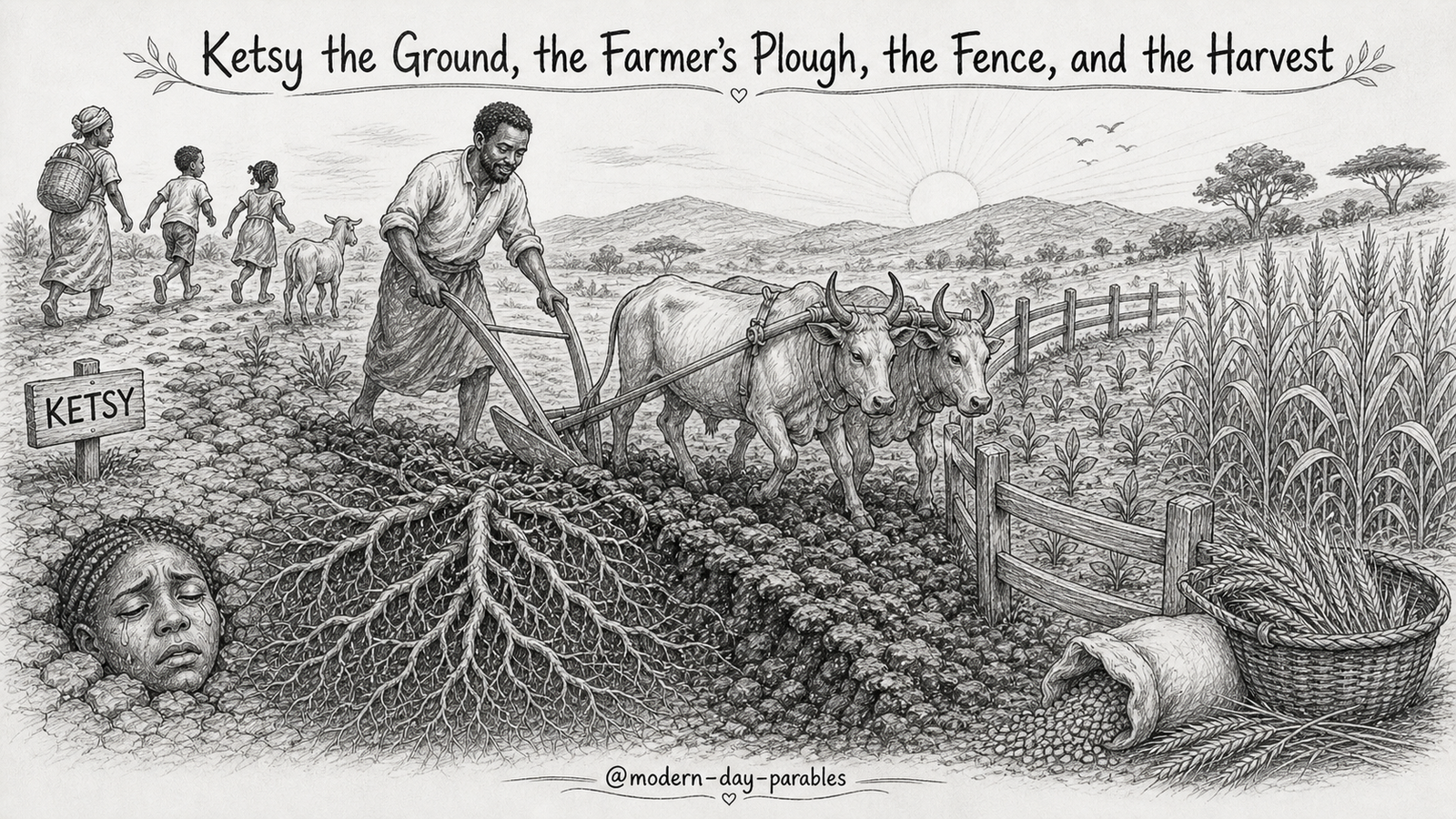
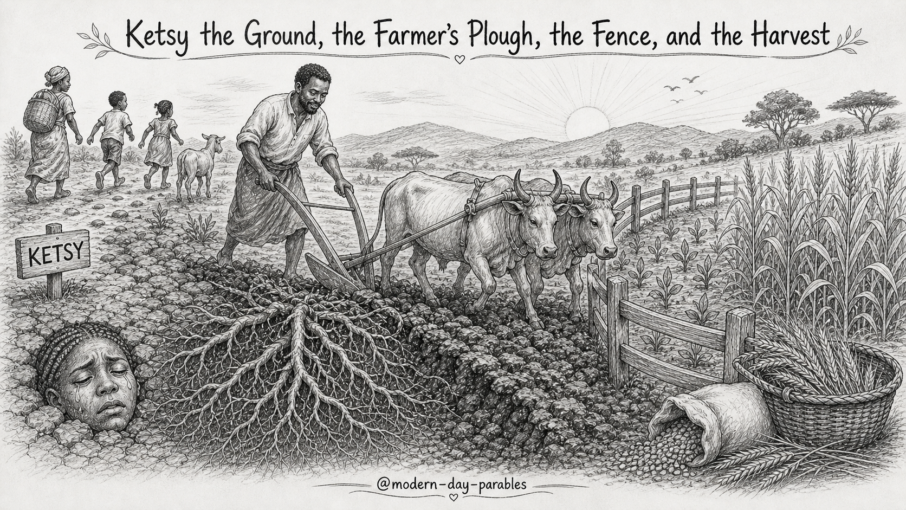
There was once a patch of ground called Kesty in the field of a patient farmer.
 
Welcome to Modern Day Parables: Ketsy the Ground, the Farmer’s Plough, the Fence, and the Harvest
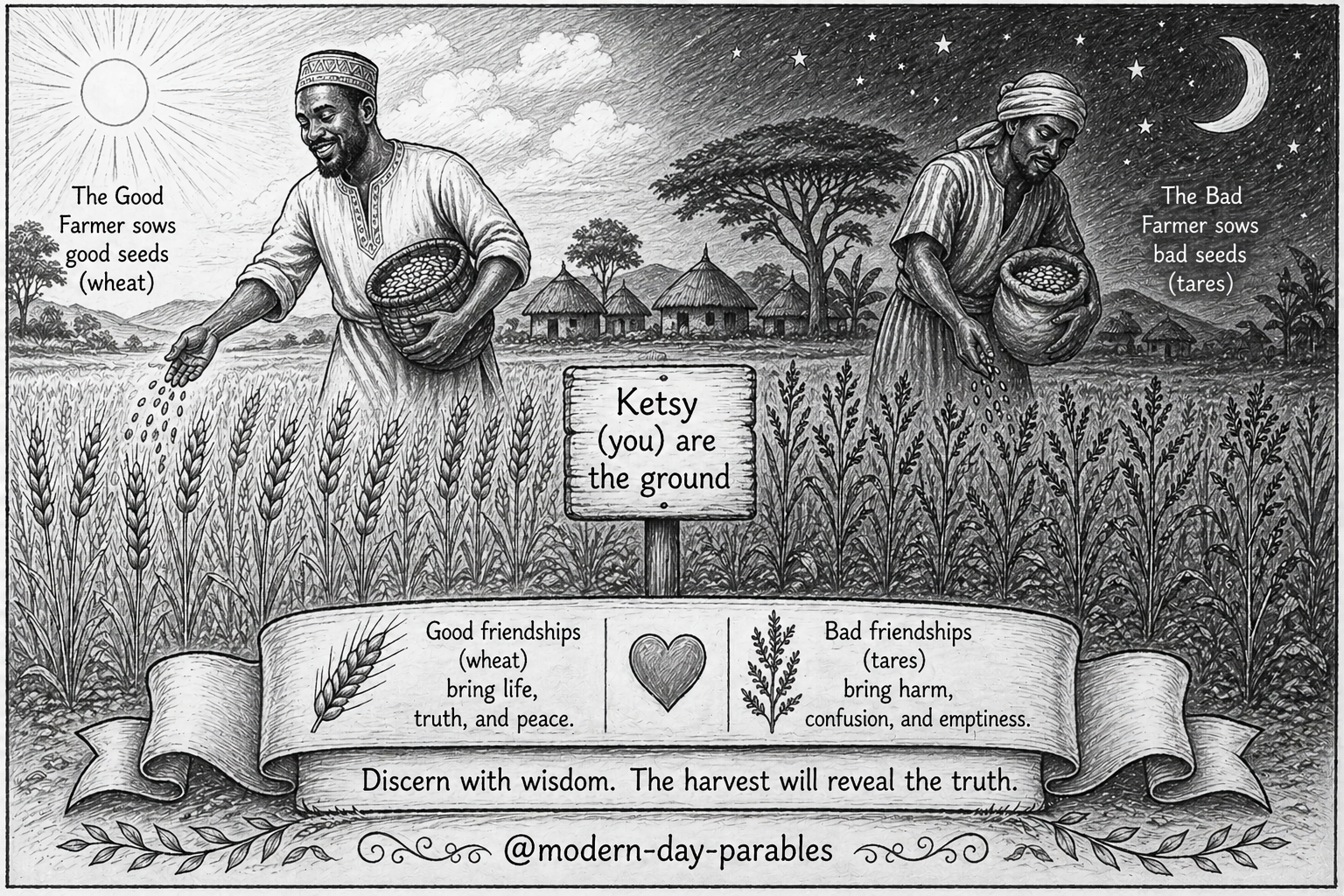
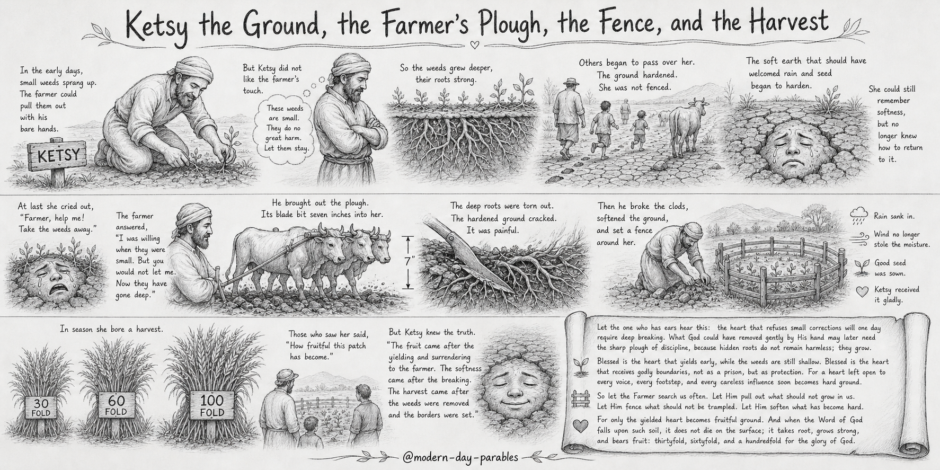
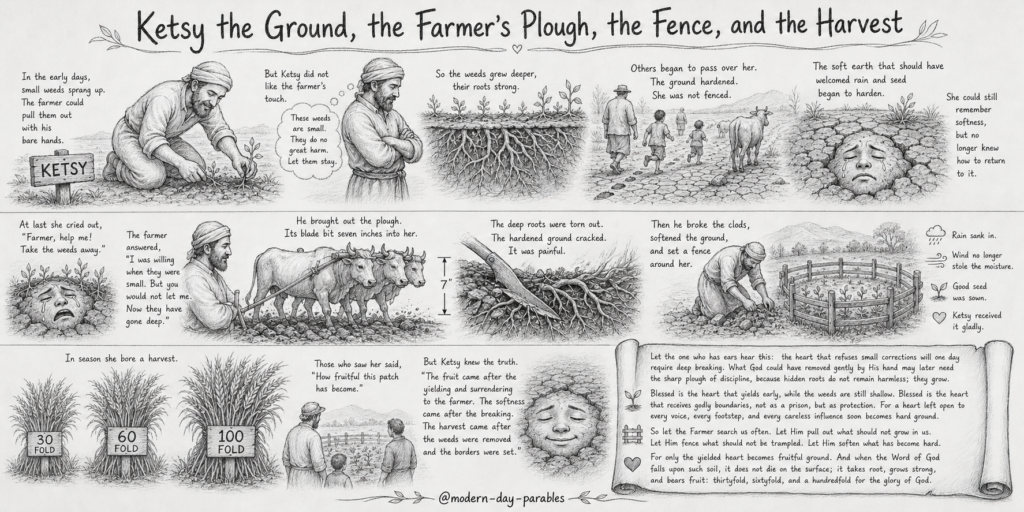
In the early days, small weeds sprang up in her. Their roots were thin, their grip was weak, and when the farmer came in the cool of the morning, he could pull them out with his bare hands. He did not wound her deeply then. He only loosened the little roots and cast them aside, so that wheat and good seed might grow in peace.
 
But Kesty did not like the farmer’s touch.
 
She said within herself, “Why must he trouble me so often? These weeds are small. They do no great harm. Let them stay.”
So when the farmer came, she resisted him. She clung to the weeds as though they were part of her, and though he warned her gently, she would not yield. Day after day the weeds remained. Week after week they thickened. What had once been green threads became stubborn roots. What had once sat near the surface sank far down into her.
 
And because Kesty would not be tended, others began to pass over her.
 
At first it was only one foot, then another. Then many feet. Men made shortcuts across her. Children ran over her. Animals trampled her. She was not fenced, and so every wandering step found a place upon her. The soft earth that should have welcomed rain and seed began to harden. The top of her became packed and stubborn. She could still remember softness, but she no longer knew how to return to it.
In time the farmer came again and stood over her in silence.
 
For the weeds had now grown strong. Their roots twisted through her like cords. They drank what belonged to the good seed. They stole her strength. And Kesty, feeling the choking weight of them, cried out at last, “Farmer, help me. Take them away.”
The farmer answered, “I was willing when they were small, and my hands were enough. But you would not let me. Now they have gone deep.”
 
Still, because he loved the field and had not forsaken her, he did not leave her as she was. He brought out the plough.
 
Its blade bit seven inches into her, and Kesty trembled. The hardened ground cracked. The deep roots were torn. The old weeds were dragged up from the places where they had hidden for so long. And because she had grown hard beneath the trampling of many feet, the breaking felt sharper than before. What could once have been removed by gentle hands now had to be cut out with iron.
Kesty wept under the plough and said, “Farmer, why does healing hurt so much?”
 
And the farmer said, “It is not because I delight in your pain. It is because what you kept has grown deep, and what was left open has grown hard. If you had let me cleanse you often, my hands would have been enough. If you had let me fence you round, the trampling would not have hardened you. But even now I plough you so that you may live.”
 
Then he broke the clods, softened the ground, and set a fence around her. He did not do this to imprison her, but to preserve her. No longer did every passer-by make a road of her. No beast wandered carelessly across her. Rain began to sink in again. Wind no longer stole all the moisture from her face. And when the farmer sowed good seed, Kesty received it gladly.
 
In season she bore a harvest. Some thirtyfold, some sixty, and some a hundredfold.
 
Then those who saw her said, “How fruitful this patch has become.”
 
But Kesty knew the truth and whispered within herself, “The fruit came after the yielding and surrendering to the farmer. The softness came after the breaking. The harvest came after the weeds were removed and the borders were set.”
 
Let the one who has ears hear this: the heart that refuses small corrections will one day require deep breaking. What God could have removed gently by His hand may later need the sharp plough of discipline, because hidden roots do not remain harmless; they grow.
Blessed is the heart that yields early, while the weeds are still shallow. Blessed is the heart that receives godly boundaries, not as a prison, but as protection. For a heart left open to every voice, every footstep, and every careless influence soon becomes hard ground.
 
So let the Farmer search us often. Let Him pull out what should not grow in us. Let Him fence what should not be trampled. Let Him soften what has become hard.
 
For only the yielded heart becomes fruitful ground. And when the Word of God falls upon such soil, it does not die on the surface; it takes root, grows strong, and bears fruit: thirtyfold, sixtyfold, and a hundredfold for the glory of God.

And the lesson is this:

 
1. Small Weeds Become Deep Roots When Left Untouched

The farmer gently pulling tiny weeds from soft soil with his bare hands, while Ketsy resists him.

Sin, bitterness, pride, unforgiveness, and compromise rarely begin deep. They begin small. What we refuse to surrender early may later require painful breaking to remove. God’s correction is gentler when our hearts remain soft.

“Catch for us the foxes, the little foxes that ruin the vineyards, our vineyards that are in bloom.” — Song of Solomon 2:15

“Today, if you hear His voice, do not harden your hearts.” — Hebrews 3:15

2. Boundaries Are Not Bondage — They Are Protection

Ketsy fenced around by the farmer while people and animals remain outside the protected ground.

A heart without godly boundaries becomes a pathway for every influence, opinion, temptation, and distraction. Godly fences protect softness, purity, peace, and spiritual growth.

“Above all else, guard your heart, for everything you do flows from it.” — Proverbs 4:23

“He who breaks through a wall may be bitten by a snake.” — Ecclesiastes 10:8

3. Broken Ground Can Still Become Fruitful

The ploughed soil now softened, receiving rain and bearing wheat thirtyfold, sixtyfold, and a hundredfold.

God does not plough us to destroy us, but to heal and restore fruitfulness. Yielded hearts receive the Word deeply and produce lasting fruit for God’s glory.

“Those whom I love I rebuke and discipline.” — Revelation 3:19

“But the seed falling on good soil refers to someone who hears the word and understands it. This is the one who produces a crop, yielding a hundred, sixty or thirty times what was sown.” — Matthew 13:23

Find more modern day parables by Patrick Omukhango and Muthoni Omukhango at:
@modern-day-parables

The Fever and the Hidden Root Cause (Week 2)

When a young girl named Kesty falls ill with a rising fever, she learns that what is seen is not always the true problem. In this thought-provoking Christian parable, discover how symptoms like anger, sadness, and loneliness mirror deeper spiritual issues—and why turning to the living Word of God is...

Read More
Subscribe to join me, let's journey together...

Leave a reply:

Your email address will not be published.

This site uses Akismet to reduce spam. Learn how your comment data is processed.

×