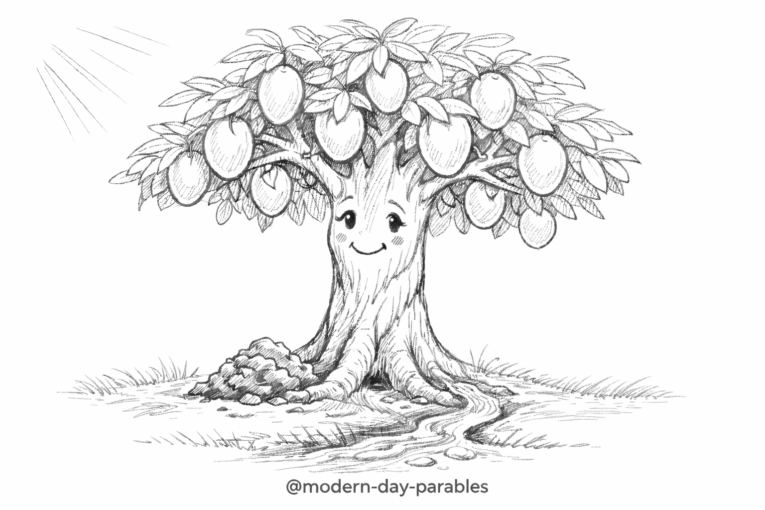
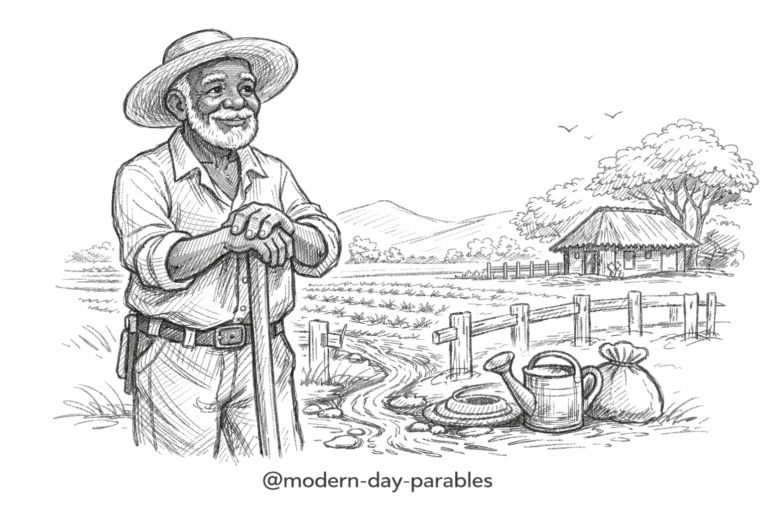
There was once a farmer who planted a young mango fruit tree called Kesty.
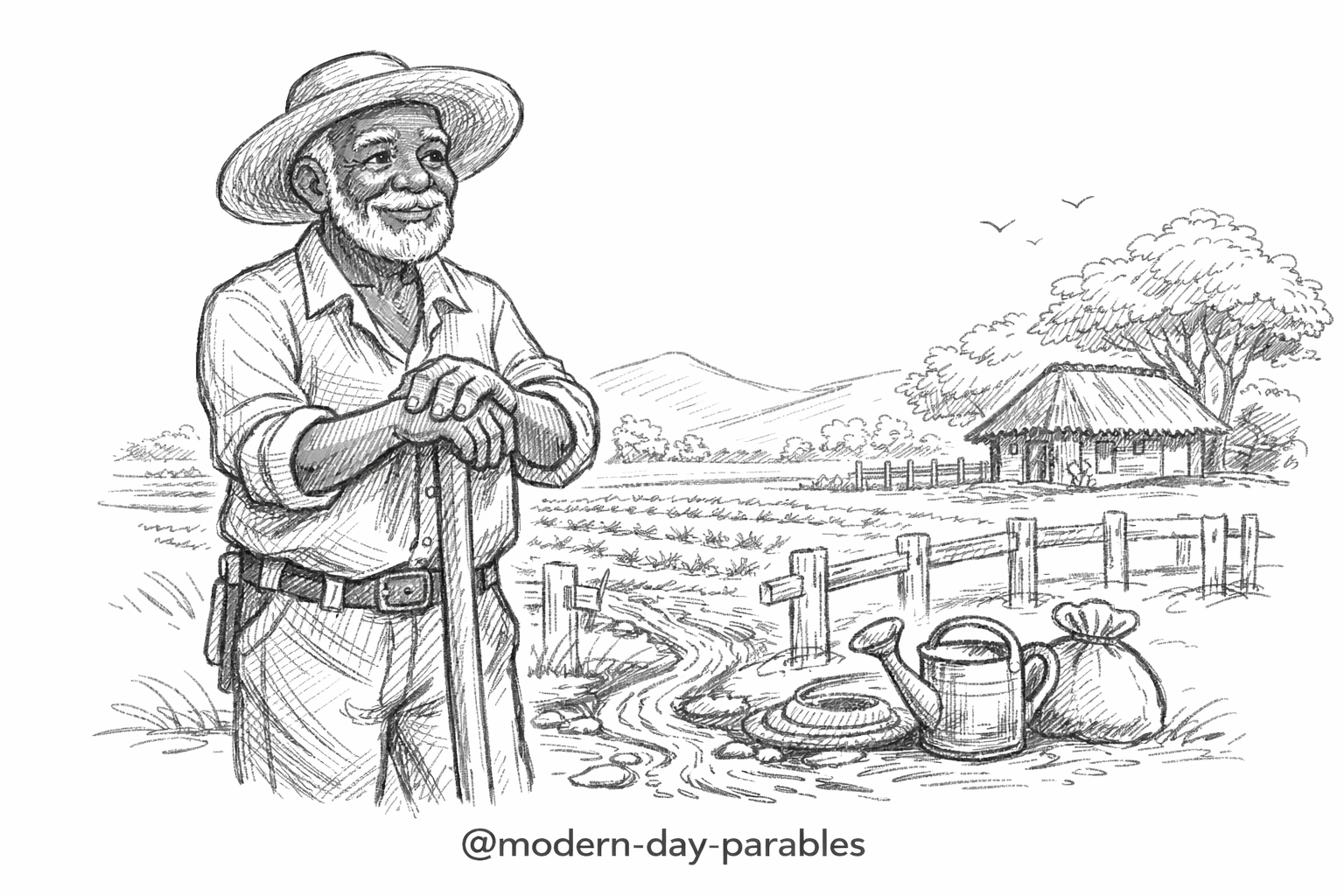
He did not plant her close to the other trees, but set her apart, with six metres between her and the rest. Around her he placed manure. He cleared the weeds from her roots. He dug a small stream so that water might come to her steadily. He watched over her with care.
Yet Kesty was not pleased.
For across the fence, in the next field, there stood another tree like her, whose name was Veroca. Veroca was not alone. Trees stood near her on every side, and weeds grew thick about her feet. Flowers and wild things sprang up nearby, and at times the air around her smelled sweet.
But around Kesty there was often the awful smell of manure.
And Kesty said in her heart, “Surely the farmer does not love me. Why else would he place such foulness around me, while Veroca stands among sweet things and pleasant company?”
From time to time the farmer came with his workers and cut away Kesty’s branches. When they had finished, she stood bare and plain, and she was ashamed of how she looked.
Then she would look across the fence and see Veroca, full in branch and untamed in beauty, and Kesty would say,
“See how lovely she is. No blade has touched her. No hand has stripped her. But I am wounded again and again.”
And Kesty’s roots did not spread far upon the surface, for the farmer had made the ground soft and deep, and her roots were taught to go downward. Veroca’s roots ran far and wide, searching this way and that for water and minerals, clinging to the upper soil to survive.
And Kesty envied even that.
She said, “Why cannot my roots be adventurous? Why am I kept in one place? Why am I fenced, pruned, fed, and hemmed in? Why am I not free like Veroca?”
So year after year Kesty murmured against the farmer and against his workers. Though she was tended, she called herself neglected. Though she was protected, she called herself caged.
Now after five years, a great drought came upon the land.
The grasses dried. The earth cracked. The wind blew hot over the fields. And Kesty, weary in spirit, said within herself, “This is the end of me. Let me wither and die. For I have never liked the life given to me.”
But as the days passed, she began to notice what had long been true.
The little stream still trickled to her roots.
No weed competed with her for strength.
The manure she had despised had made her rich in nourishment.
The pruning she had hated had made her branches strong enough to bear weight.
Her roots, which had gone deep rather than wide, found life hidden far below the dry ground.
And then Kesty felt upon her branches the heavy pull of fruit.
It was more fruit than she had known before.
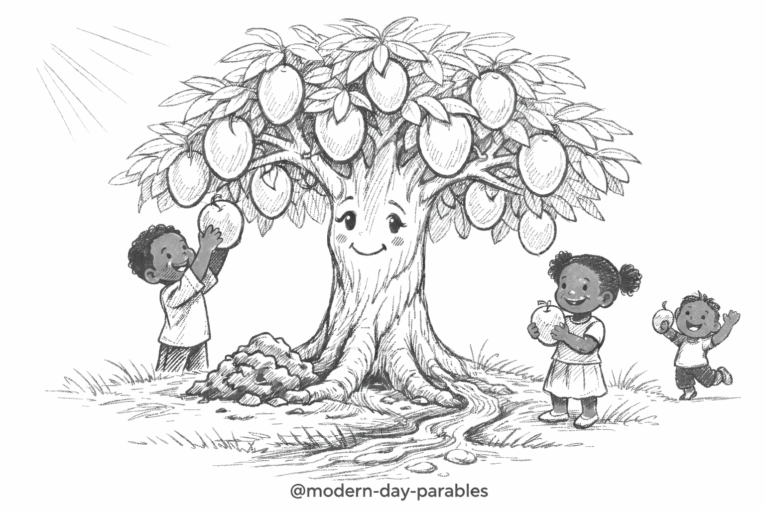
Men, women, and children came near her in the heat of the drought. They rested in the cleared ground around her. They reached up, took of her fruit, and their faces were filled with gladness. Some ate and were refreshed. Some carried her fruit home to their households. Some blessed the farmer for the sweetness they had found.
Then for the first time Kesty understood a joy greater than being admired. She was glad to be useful.
And when she looked across the fence to Veroca, her heart trembled. For Veroca had no fruit.
The weeds around her had grown high and thick, and had become almost a shrubbery. They drank much of the little water that was left and stole the strength from the soil. Her roots had spread wide, but the surface earth was dry. Her branches were many, but empty. Her ground was so overgrown that no one wished to come near. No child rested there. No family gathered there. No hand reached up in thanksgiving.
Then Kesty knew that what she had once called freedom had been Veroca’s ruin.
And she remembered all her complaints against the farmer, and was ashamed. For the farmer had not hated her. He had prepared her.
He had not shamed her with manure. He had fed her.
He had not wounded her by pruning. He had strengthened her.
He had not isolated her to punish her. He had given her room to grow.
He had not denied her wandering roots. He had led them deep, where drought could not destroy them.
And Kesty learned that a fruit tree is not praised because it looks full in branches, but because it bears fruit that feeds others.
And she ceased from envying the tree beyond the fence.
For in the day of testing, it is not the prettiest field that matters, but the life that remains and the fruit that can still be given.
And the lesson is this:
1. Some lives seem harder because they are being tended with greater purpose.
2. What smells unpleasant may be the very thing feeding you.
3. What feels like cutting may be the mercy that saves your strength.
4. What feels like separation may be protection for fruitfulness.
5. And when the dry season comes, deep roots will speak more loudly than beautiful branches.
Our Scripture today:
Hebrews 12:6
“because the Lord disciplines the one he loves, and he chastens everyone he accepts as his son.”
It echoes an older wisdom:
Proverbs 3:12
“because the Lord disciplines those he loves, as a father the son he delights in.”
And those who endure His wise care shall, in due season, bear fruit that remains.
He who has ears to hear, let him hear. What the Spirit of God is saying!
Find more modern day parables by Patrick Omukhango and Muthoni Omukhango below! Every week!
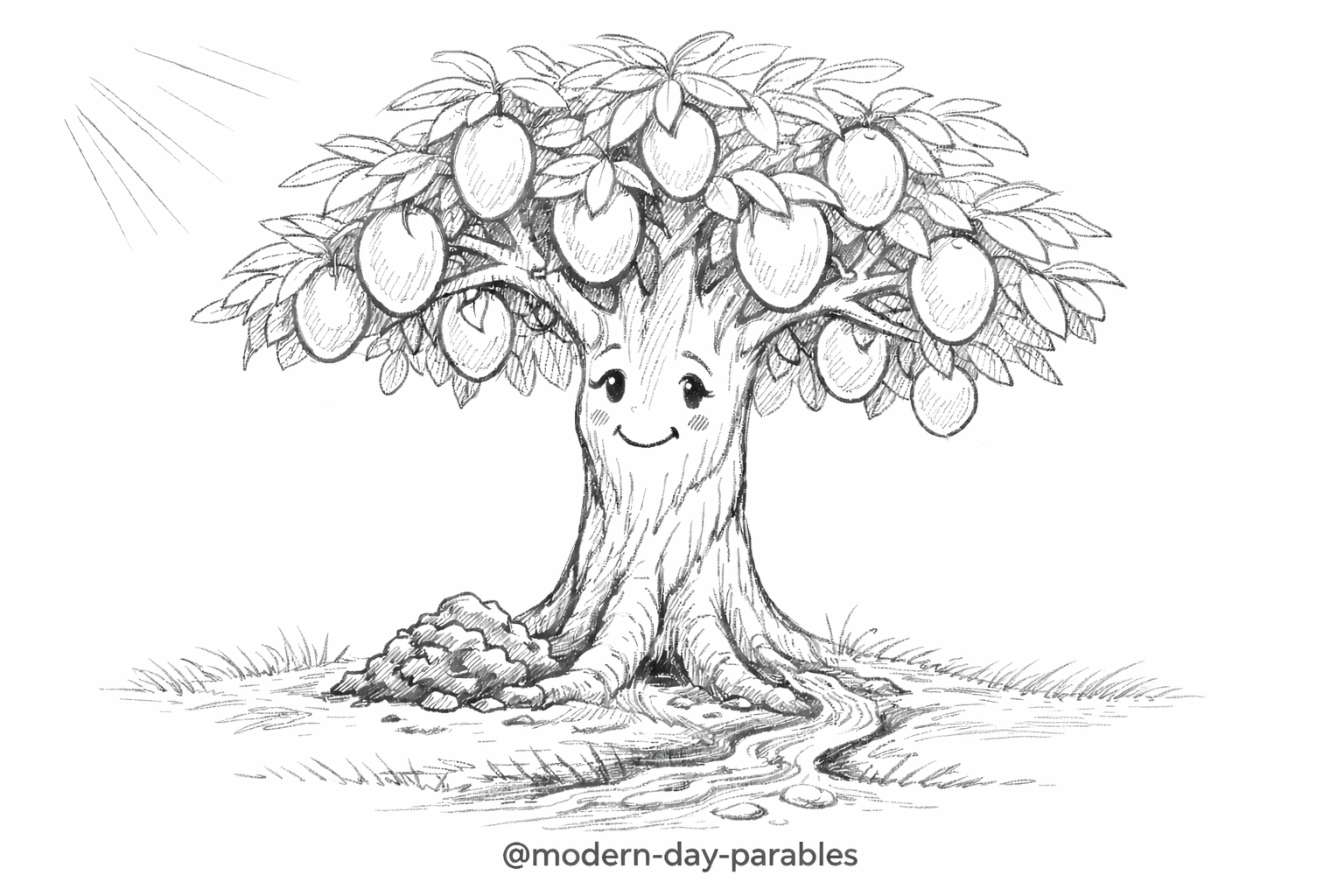
The Tree That Complained Against the Farmer; And What She Later Discovered
The Tree That Complained Against the Farmer (And What She Later Discovered) is a thoughtful parable about a lonely mango tree that misunderstands the care of her farmer. Set apart, pruned, and surrounded by manure, she envies a freer tree beyond the fence—until a season of drought reveals a deeper...
Read MoreSubscribe to join me, let's journey together...